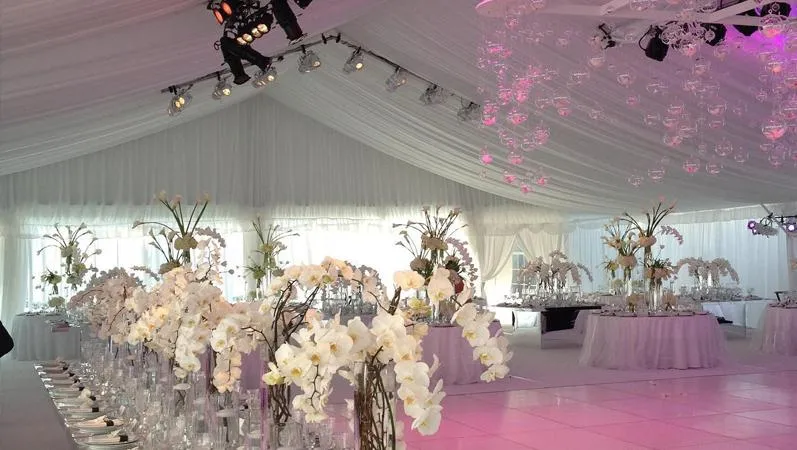
Lighting Trends That Transform Your Tented Gala in Long Island
A tented gala on Long Island has a unique kind of magic. There’s the open air, the coastline breeze, the way the horizon looks just before the sun drops. But after sunset, the event becomes something else entirely. Lighting takes over as the defining design element. It dictates how guests feel, where they look, how the space breathes, and what is remembered.
Great lighting doesn’t simply “brighten” a tent — it creates atmosphere. It turns a tent into an evening environment with dimension, presence, and personality.
And lately, lighting trends are shifting away from simple uplighting and string lights toward immersive lighting experiences that shape the room.
Why Lighting Matters More in a Tent Than an Indoor Venue
Inside a tent, lighting has no architectural support to lean on. There are no walls to bounce off, no ceiling beams to anchor mood. So the lighting must become the structure — the tone-setter, the room-builder, the storyteller.
On Long Island — where event tents often sit in dramatic outdoor settings — lighting helps frame the landscape instead of competing with it. The trees outside become silhouettes. The shoreline becomes a gradient. The ceiling becomes a canvas.
Lighting is not an add-on.
It’s the design language of the gala after sunset.
Trend 1: Layered Lighting Creates Dimension, Not Just Brightness
This is where many events go wrong — they rely on one lighting source. The entire tent ends up looking flat.
Layered lighting builds depth:
Ambient (general glow)
Highlighting (focal points like bars, stages, speakers)
Accent (texture, warmth, intimacy)
Decorative (statement pieces that function as décor)
Layering turns the ceiling into a sky, the tables into islands of conversation, and the dance floor into a gravitational center.
Even if the concept is subtle, the result feels expensive.
Trend 2: Statement Chandeliers in Sailcloth Tents
Some tents don’t need chandeliers — but sailcloth tents sing under them.
Because the fabric diffuses light so gracefully, chandeliers become floating points of radiance rather than “fixtures.” They create a warm anchor to the space. The tent feels lifted instead of covered. And when paired with florals or draped greenery, chandeliers feel lush rather than formal.
This is especially powerful in vineyard galas, charity events, and waterfront fundraisers where natural elegance matters more than glamor.
Trend 3: Bistro + Market Lights for Movement and Soft Glow
This is not about string lights hung in straight predictable lines.
The trend now is:
Soft zig-zags
Sweeping arcs
Lighting that responds to the tent’s shape
In sailcloth and pole tents, bistro lighting emphasizes the peaks and curves. In clear-tops, it feels dreamlike because the lights reflect back into the canopy. Guests look up — and the ceiling looks alive. The event becomes immersive rather than simply lit.
This works beautifully for gala dinners that roll into dancing, where mood shifts gradually.
Trend 4: Pinspotting for Tables and Florals
In a tent, table arrangements can disappear once daylight fades if not lit intentionally.
Pinspotting places small, narrow lighting beams above each table — making florals, glassware, and tablescapes glow from within instead of being washed in general light.
It’s subtle — but it creates:
Depth
Contrast
Intimacy
Luxury
This is the technique behind “magazine cover” gala dinners.
Trend 5: Lighting That Extends Beyond the Tent
One of the most overlooked opportunities in tented galas is the world outside the tent.
When you illuminate:
Tree lines
Garden edges
Stone walls
Waterfront edges
You create a sense of place rather than a “room outdoors.” It pulls the environment into the event, rather than trapping guests inside a glowing bubble.
The boundary between indoors and outdoors dissolves — the gala feels bigger than the tent itself.
How to Choose the Right Lighting for Your Gala
Choosing lighting is less about style and more about intention.
Use this guide as a starting point:
Define the emotional tone — romantic, dramatic, modern, warm, luminous.
Identify the architectural feature of your tent — peak height, clarity, diffusion.
Consider how the event transitions — cocktail → dinner → dance.
Choose one visual anchor — chandelier, canopy arcs, or landscape lighting.
Let everything else support that anchor — not compete with it.
When lighting has a hierarchy, the gala feels composed.
When everything is competing, the room feels loud.
FAQs
Does the tent type affect what lighting works best?
Yes. Sailcloth diffuses light; clear tops reflect it; frame tents require intentional focal points.Can lighting be adjusted throughout the night?
Absolutely. Good lighting design is dynamic, not static. It shifts as the event flows.Is more lighting always better?
No. Too much light makes a tent feel flat. Contrast and shadow are what create atmosphere.
Conclusion
Lighting is how a tented gala becomes an experience instead of a setup. It guides mood, expression, movement, and memory. When done well, lighting doesn’t just “show the event” — it becomes part of the story.
On Long Island, where the outdoors is already a stage, lighting simply reveals it.
